

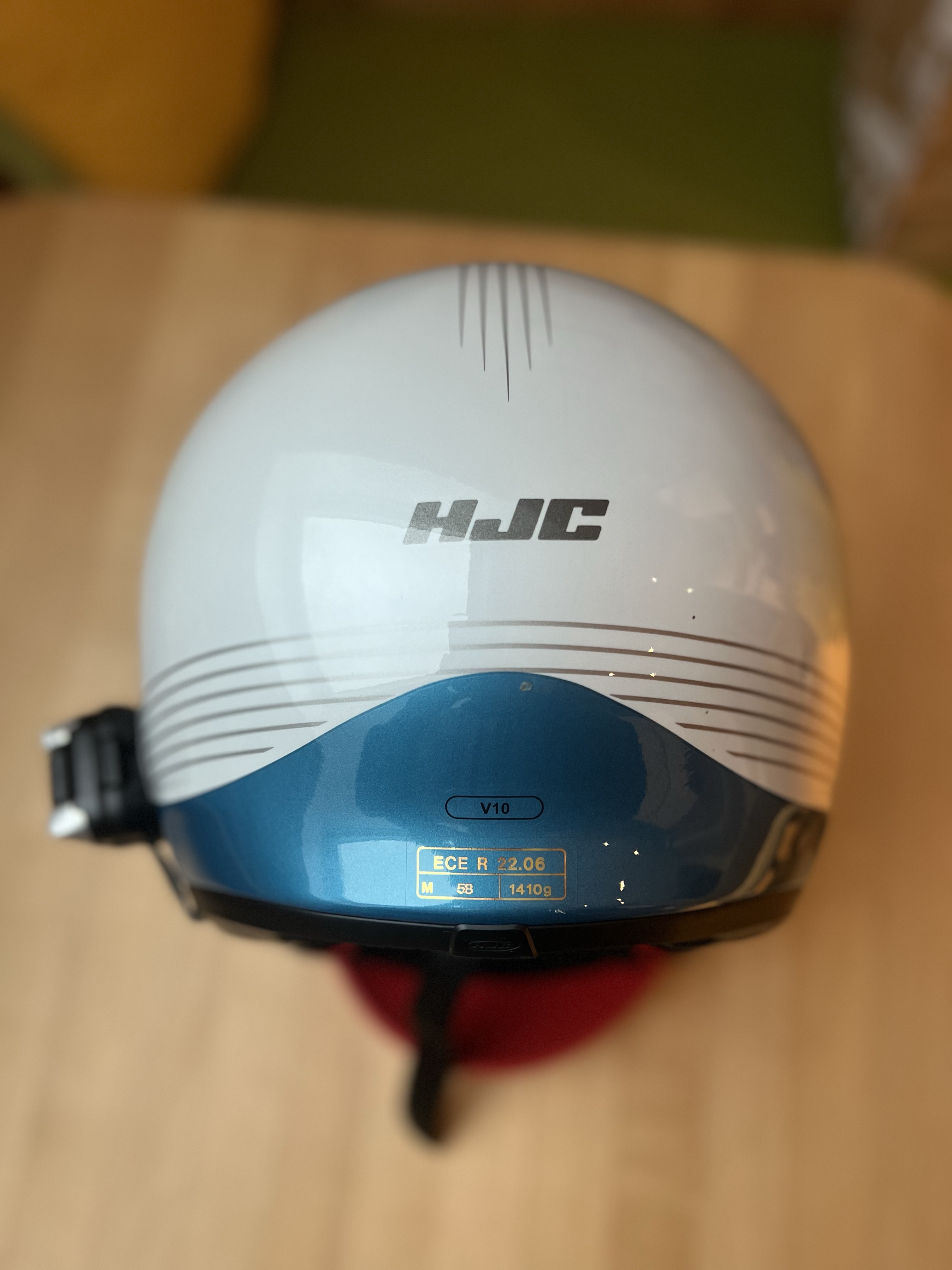
Der brandneue HJC V10 geht über den klassischen Vintage-Look hinaus und bietet zusätzlich jede Menge New-Age-Features. Neben der leichten Fiberglasschale (1.410g) überzeugt er durch eine sehr gute Aerodynamik, Notfalltabs für zusätzliche Sicherheit bei einem Unfall, eine effektive Belüftung, herausnehmbare und waschbare Innenpolster und robuste Schnellverschlussschrauben für einen schnellen Visierwechsel. Natürlich ist er wie die meisten HJC-Helme auch Kommunikationsbereit, z.B. mit dem Smart HJC 10B oder 20B von Sena, oder auch mit anderen Systemen wie dem von mir bevorzugten Cardo Packtalk Bold oder Edge.


Design und Komfort
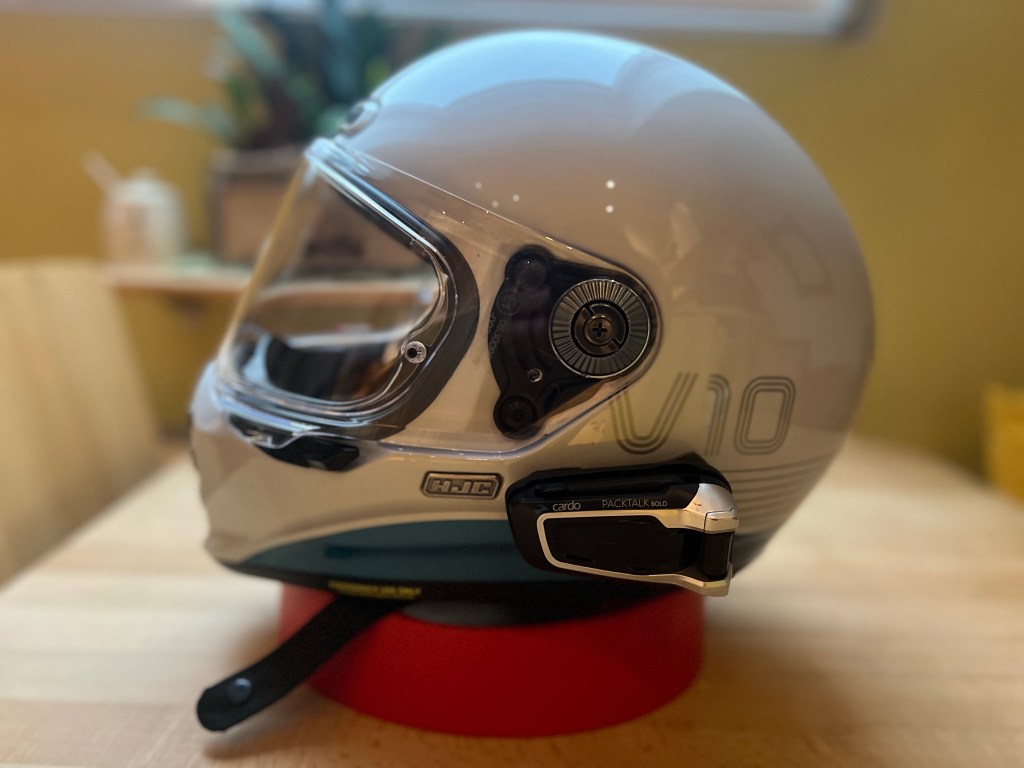
Bei den Designs geht die Retrolinie weiter, denn auch hier vermischt sich Vintage sehr deutlich mit Modern. Mein V10 im Tami-Design liegt irgendwo dazwischen. Wer es eher retro mag, kann hier auf die Version Foni oder Solid zurückgreifen, wer es flippiger und noch moderner mag, nimmt Vatt oder gar Grape. Alle gemeinsam haben zumindest auf meinem Kopf eine sehr gute Passform. Tatsächlich (und das ist kein Witz) ist es der bisher angenehmste zu fahrende Helm auf meiner BMW mit der Wunderlich Trophy Verkleidung, seit ich sie 2010 gekauft habe. Wenn ich bei ihm das Visier vorne mit einem Klick einraste, habe ich sofort das Gefühl, vom Fahrtwind und seinen rauen Geräuschen abgeschirmt zu sein. Nicht so, dass man nichts mehr von der Außenwelt und der Fahrt mitbekommt, nein, ein angenehmes Gefühl der Ruhe im Helm und um die Ohrmuscheln herum. Das kannte ich bisher so nicht, auch nicht von wesentlich teureren Helmen anderer Hersteller.

Belüftung
Die Belüftung ist je nachdem welche Verkleidung ggf. am Motorrad verbaut ist gut bis effektiv. Das hängt natürlich wie bei allen anderen Helmen auf dem Markt auch von hohen Verkleidungsscheiben am Bike, Nacked, oder eben anderen Styles ab. Wobei bei den bisherigen Testfahrten auch ein wenig die Kopfhaltung eine gewisse Rolle gespielt hat, wie die Zuluft durch die Öffnungen in den Helm kam.
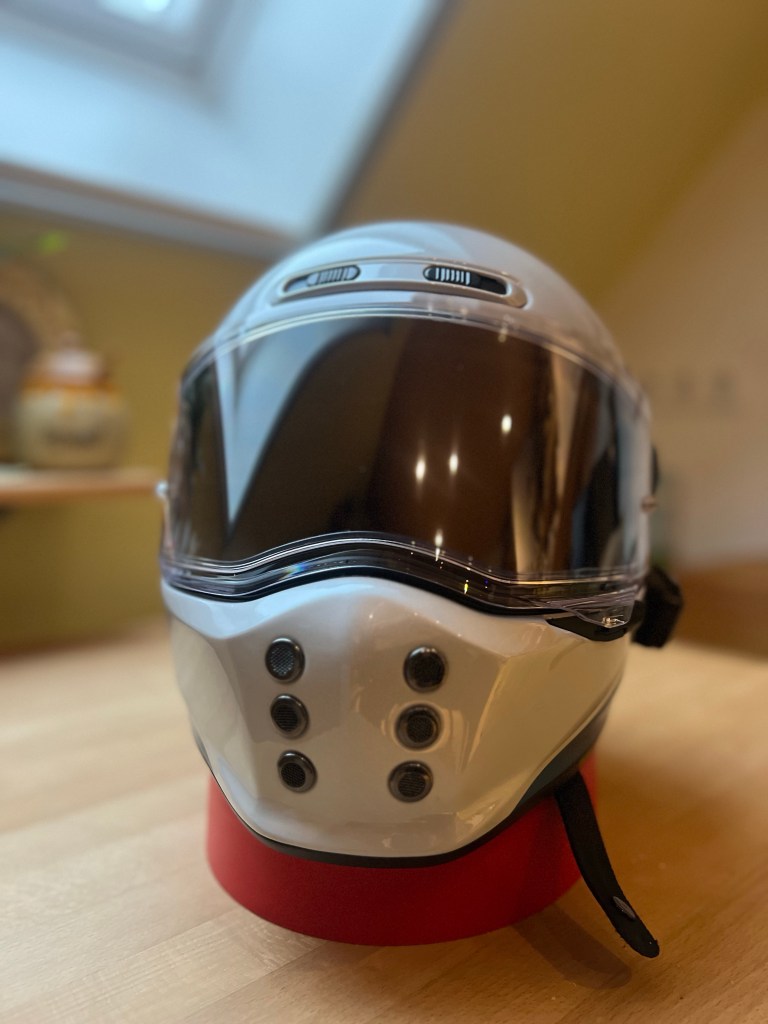
Die Bedienung der beiden kleinen Lufteinlässe oberhalb des Visiers ist dabei wirklich einfach und auch mit dicken Handschuhen leicht zu schaffen. Das Öffnen und Schließen der sechs Belüftungspunkte am Kinn muss jedoch von innen mit einem Schieber vorgenommen werden. Hier dachte ich zuerst, das geht natürlich nur im Stehen *hmmmm*. Während der Fahrt wäre es gefährlich und zugleich super fummelig, gerade auch mit dickeren Handschuhen. Bis ich bei einer der letzten Ausfahrten zufällig feststellte, dass der Schieber so leicht zu bedienen ist, dass man das Öffnen und Schließen mit leicht vorgeschobenem Kinn und einer nach unten oder nach oben Bewegung machen kann. Das erleichtert die Sache natürlich ungemein und geht auch während der Fahrt schnell von der Hand, bzw. vom Kinn. Zusätzlich kann auch das Visier selbst als zusätzliche Belüftungsöffnung genutzt werden, da man es einen Spalt weit öffnen kann, was den Kühlungseffekt insgesamt noch verbessert.

Visier
Der V10 wird mit einem hellen und einem dunklen Visier (ab November erhältlich) geliefert. Das einzige offensichtliche Manko des Helmes ist daher aus meiner Sicht das Fehlen einer Sonnenblende. Es ist wirklich schade, dass er keine hat, aber auch nicht ungewöhnlich für einen Helm, der mehr in das Vintage-Schiene passen soll. Als kleinen Ersatz hat HJC daher beim V10 den Visierwechsel mit den oben schon erwähnten sehr robusten Schnellverschlüssen realisiert, die den Tausch ganz einfach machen. Ein Nachteil bleibt allerdings, nämlich dass man immer eines der Visiere irgendwie transportieren muss, wenn man mal länger unterwegs ist. Oder man macht es als Alternative wie ich in der letzten Zeit und fährt einfach mit Sonnenbrille.
Und apropos Visier! Sehr fortschrittlich ist die neuerdings angepasste (ausgesparte) Innenseite des Hauptvisieres, denn das Pinlock wird dadurch an gleich drei und nicht wie bisher an nur zwei Punkten fixiert. Ein Verrutschen wie bisher ist somit kaum mehr möglich, was die Haltbarkeit beider Visiere am Helm deutlich erhöht.
Sicherheit
Wie bei seinen anderen Helmen setzt HJC auch beim V10 auf Sicherheit. Zum einen mit einem sportlichen Doppel-D-Riemenverschluss. Zum anderen ist er mit seiner Glasfaserverbund-Schale selbstverständlich nach ECE 22.06 geprüft und übertrifft die hier geltenden Normen zum Teil sogar. Die Notfall-TABs in Form von herausnehmbaren und gleichzeitig äußerst angenehmen Wangenpolstern erleichtern den Helfern nach einem Unfall die Arbeit und das Abnehmen des Helmes. Der V10 bietet somit einen sehr guten Rundumschutz und darüber hinaus ein großes Sichtfeld für die passive Sicherheit bei der eigenen Sicht auf das Verkehrsgeschehen.
Fazit
Nachdem der V10 gewissermaßen als Ersatz für den RPHA91-Testhelm zu mir kam, muss ich sagen, dass er aus meiner Sicht keine Schwächen aufweist. Einzig die fehlende Sonnenblende könnte man als Manko ansehen. Ansonsten bekommt man einen durchdachten, sicheren und zugleich ausgereiften modernen Vintage Helm, der seinen Preis von runden 330,00 Euro einfarbig und 370,00 Euro in den buten Designs wert ist. Ergänzt durch das dunkle Visier ist er perfekt für längere Touren, denn sowohl das Gewicht mit 1410 Gramm als auch die Geräuschkulisse im Inneren mit den bequemen Polstern machen ihn zu einem ausgereiften Reisebegleiter, den man zudem nicht an jedem Motorradspiegel hängen sieht.

In diesem Sinne selber testen und probieren der HJC V10 es den Versuch allemal wert.
Euer Torsten Thimm
HJC V10 Vintage in a modern guise.
The brand new HJC V10 goes beyond the classic vintage look and also offers plenty of new-age features. In addition to the lightweight fibreglass shell (1,410g), it convinces with very good aerodynamics, emergency tabs for additional safety in case of an accident, effective ventilation, removable and washable inner pads and robust quick-release screws for fast visor changes. Of course, like most HJC helmets, it is also communication ready, e.g. with Sena’s Smart HJC 10B or 20B, or with other systems such as my favourite Cardo Packtalk Bold or Edge.
Design and comfort
When it comes to designs, the retro line continues, as here too vintage is very clearly mixed with modern. My V10 in the Tami design is somewhere in between. If you like it more retro, you can go for the Foni or Solid version, if you like it funkier and even more modern, you can go for Vatt or even Grape. All of them have a very good fit, at least on my head. In fact (and I’m not kidding) it’s the most comfortable helmet to ride on my BMW with the Wunderlich Trophy fairing so far, since I bought it in 2010. When I click the visor into place at the front, I immediately have the feeling of being shielded from the wind and its harsh noises. It’s not that you can’t hear anything from the outside world and the ride, no, it’s a pleasant feeling of peace in the helmet and around the ear cups. I’ve never experienced that before, not even with much more expensive helmets from other manufacturers.
Ventilation
The ventilation is good to effective, depending on which fairing is installed on the motorbike. Of course, as with all other helmets on the market, this depends on high fairing panels on the bike, naked, or other styles. During the test rides so far, the head position has also played a certain role in how the air enters the helmet through the openings.
The operation of the two small air inlets above the visor is really simple and easy to manage even with thick gloves. Opening and closing the six ventilation points on the chin, however, has to be done from the inside with a slider. At first I thought that this could only be done while standing *hmmmm*. While riding it would be dangerous and at the same time super fiddly, especially with thicker gloves. Until, on one of the last rides, I discovered by chance that the slider is so easy to operate that you can open and close it with your chin slightly forward and a downward or upward movement. Of course, this makes things a lot easier and can also be quickly removed from the hand or chin while riding. In addition, the visor itself can be used as an additional ventilation opening, as it can be opened a crack wide, which improves the overall cooling effect.
Visor
The V10 comes with a light and a dark visor (available from November). The only obvious shortcoming of the helmet, in my view, is therefore the lack of a sun visor. It’s a real shame that it doesn’t have one, but also not unusual for a helmet that is meant to fit more into the vintage track. As a small substitute, HJC has therefore implemented the visor change on the V10 with the very robust quick-release fasteners already mentioned above, which make the swap quite easy. One disadvantage remains, however, namely that you always have to transport one of the visors somehow when you are on the road for a longer period of time. Or, as an alternative, you can do what I’ve been doing lately and just ride with sunglasses.
And speaking of visors! The newly adapted (recessed) inside of the main visor is very progressive, because the Pinlock is fixed at three points and not just at two, as before. Slippage, as before, is therefore hardly possible, which significantly increases the durability of both visors on the helmet.
Safety
As with its other helmets, HJC also focuses on safety with the V10. On the one hand, with a sporty double-D strap closure. Secondly, with its glass fibre composite shell, it is of course tested according to ECE 22.06 and in some cases even exceeds the standards that apply here. The emergency TABs in the form of removable and at the same time extremely comfortable cheek pads make it easier for helpers to work and remove the helmet after an accident. The V10 thus offers very good all-round protection and, in addition, a large field of vision for passive safety in one’s own view of the traffic scene.
Conclusion
After the V10 came to me as a kind of replacement for the RPHA91 test helmet, I have to say that it has no weaknesses from my point of view. Only the missing sun visor could be considered a shortcoming. Otherwise, you get a well thought-out, safe and at the same time sophisticated modern vintage helmet that is worth its price of around 330.00 euros in one colour and 370.00 euros in the buten designs. Complemented by the dark visor, it is perfect for longer tours, because both the weight of 1410 grams and the noise level inside with the comfortable pads make it a mature travel companion that you also won’t see hanging from every motorbike mirror.
With this in mind, test and try the HJC V10 for yourself – it’s well worth the effort.
Your Torsten Thimm

 TT MotorBike Blog